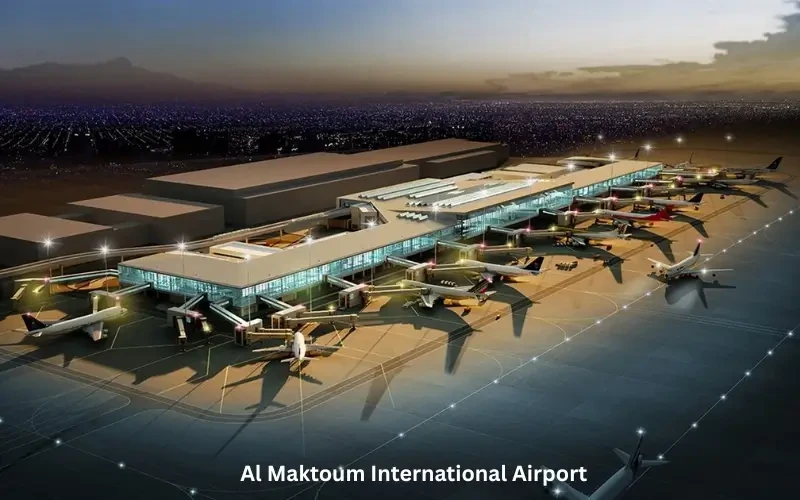
Al Maktoum International Airport: Dubai's Bold Bet on the Future of Flying
In Dubai, everything is done on a grand scale. The Dubai International Airport, for example, which is, on a regular day, teeming with millions of passengers from different parts of the world who navigate almost effortlessly through it and making it one of the busiest terminals in the world, is like a gated community of passenger terminals. However, it seems even this fantastic aviation station is getting congested.
Coming to the scene is Al Maktoum International Airport, or DWC in the aviation field. Located approximately 37 kilometers south of the center of Dubai, this is not only another extension project of an airport, but it is also Dubai's bold attempt to change the rules of air travel utterly.
The Numbers Gamehttps://greatdubai.com/blog/guide-to-dubai-international-airport-terminal-1
Let's take a moment to talk about dimensions. After its completion, Al Maktoum will become the biggest terminal in the world and will accommodate 220 million passengers a year. To give some context, the number is equivalent to the total number of people in Germany, France, and the UK that could potentially go through one airport per year. The airport that is currently the most trafficked worldwide, Atlanta's Hartsfield-Jackson, tackles approximately 110 million travelers yearly - the other half of that of DWC's use.
The terminal project will eventually include five parallel runways that will make it possible to handle twice the amount of air traffic and the A380 which is the largest available commercial aircraft. However, unlike many airports, which have evolved in a stop and go fashion through decades, with a terminal and runway thrown in here and there, the designers of Al Maktoum were not afraid to think big since it was designed to start with.
Geography Is Destiny
Al Maktoum takes full advantage of a crucial factor in Dubai's location. If you take a map, draw a radius of 8 hours from Dubai, what you have is more than 2/3 of the world's population encircled. The question arises why airlines prefer using Dubai as an obvious stopover.
Still, it is not only geography. Dubai's Hamad International airport and Abu Dhabi's Zayed International might be tough competitors but they seem to represent something different in the case of the Dubai South city- the future. The latter isn't merely an airport with a nearby city; it's an entire ecosystem built around air traffic.
The Reality Check
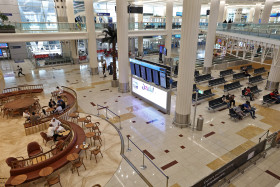
However, this is the part that gets exciting. Al Maktoum's passenger traffic is still low despite its opening in 2013. Right now there are only limited travelers in the terminals as you will find an eerie calmness amid the impressive architecture.
At present, the airport is mainly a cargo hub and it deals with some flydubai flights, but the huge array of passenger terminals seems like a staged theater that is waiting for its main act. This is not an outright failure, rather it is comparable to a high-premium dress rehearsal.
The difficulty has to do with the very careful coordination that is essential for the transition of several airlines and routes from the congested Dubai International without interrupting Dubai's function as a global center. Emirates, Dubai's flagship carrier, and one of the biggest airlines in the world are, for obvious reasons, taking a careful approach to relocating to a new airport.
Environmental Contradictions
Dubai seems to be an interesting paradox in relation to sustainability. The city has a great emphasis on green building standards as well as LEED certifications for the Al Maktoum airport. We have the design of the airport that features the recycling of water, energy-efficient cooling, and eco-friendly waste management programs which look good on paper.
But that doesn't make the main problem go away. Constructing and operating the world’s largest airport is not exactly what most environmentalists would call as sustainable. The carbon emissions that are released as a result of constructing such a huge terminal, in addition to the flights it will allow, create a dilemma between the green targets and the growth-at-any-cost agenda of Dubai.
The Technology Angle
Al Maktoum will be a so-called "smart airport" featuring, in practice, biometric scanners for face recognition, sensors that monitor crowd flow, toilet paper levels, and automated systems that handle baggage with the least human involvement. Some of these devices have been tried successfully in other fields; a few are not yet in the real world but rather in a laboratory.
It will be the ultimate proof when the airport's facilities receive millions of passengers. The technology that definitely runs well with a load of hundreds can drop down spectacularly in the chaos peak travel seasons like flight cancellations.
Economic Realities
In the years of decline in oil dependency, aviation has played a prominent role. The leadership of the emirate is very straightforward that the building of the largest airport in the world will make Dubai the key player in global aviation for the following centuries.
This move is very sensible in different aspects. Global travel demand for aviation, notably in the Asian and African markets is projected to peak at a very high level in the years to come. Dubai's position in this case is absolutely right. But all this still remains a gamble; and an expensive one as well.
In addition, there are players that don't sleep. Qatar is still advancing Doha, Saudi Arabia is putting money into the aviation sector, while Istanbul is becoming a strong competitor both in East and West flight booking.
The Passenger Experience Experiment
The scaling up of Al Maktoum will bring a revolution in the way airports are viewed. Thanks to the terminal design that creates more space and allows more light than hippo malls, compared to other airports that have been stretched and bent, this one stands out.
Visitors recount the feeling of walking through a terminal that resembles an upscale shopping mall more than a typical airport corridor. The question remains, will this feeling of spaciousness and calm withstand the pressure of the millions of guests, funny kids, delayed flights, and other inconveniences of modern air travel?
The Waiting Game
One of the most fascinating things about Al Maktoum International Airport is that so much is still left to be written. There's already an established infrastructure, a clear vision, yet the execution depends on what lies outside of Dubai's direct control – economic growth on a global scale, airline route decisions, passenger preferences, and geopolitical stability in the region.
Dubai has proven time and again that it can accomplish even the seemingly crazy projects. The Palm Jumeirah, Burj Khalifa, and Dubai International to a global hub transformation was very ambitious but eventually, they all succeeded even though not always in the expected time or as originally believed.
Greatest Aviation Gamble
Al Maktoum International will be Dubai’s greatest aviation gamble yet. On the other hand, being successful will ensure that Dubai is at the center of global air travel for decades to come. In the meantime, if it achieves mediocre results or even fails, it will be standing with the most expensive white elephant on earth.
Over the next ten years, it is likely to be determined which one of the two trends will prevail. Presently, Al Maktoum is just a beautifully designed hallmark of aspiration, waiting for its time either to shine or to fall dismally like a tale proving there are limits to such dreams.
It will surely be an experience to watch, regardless of whether it is a success or not.